


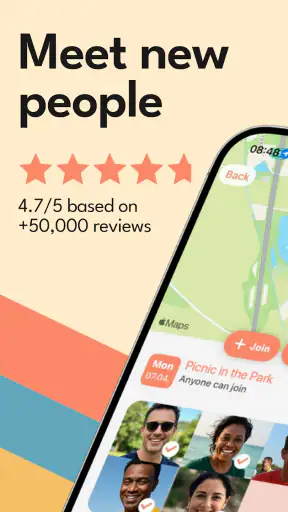
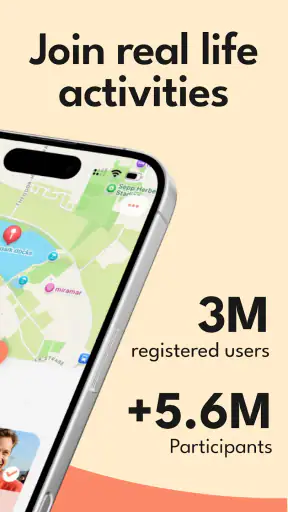

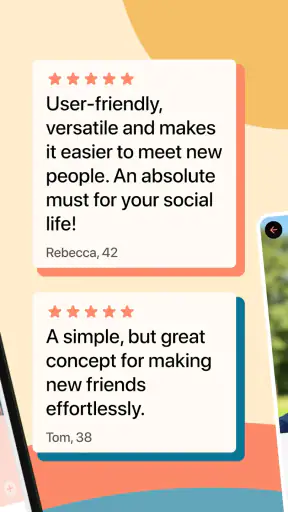


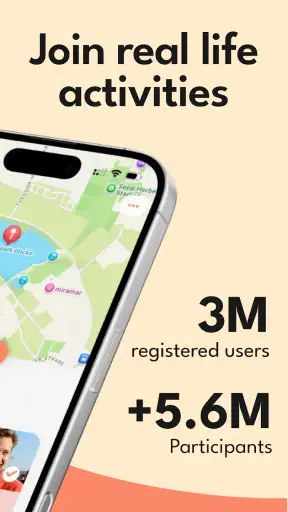
Meeting people through an app sounds simple until you try to turn an online connection into a comfortable real-world activity. Meet5 takes a more activity-focused approach than a typical one-to-one social or dating service. Its purpose is to help people meet others, make friends, and join activities, which makes the app especially interesting for anyone who wants a social plan rather than an endless stream of private messages.
I reviewed it as a lifestyle app from Meet5 GmbH, and my overall impression is that its value depends less on browsing profiles and more on whether you are willing to take part. It is free to install, rated for Teen users, and available on devices running Android 8.0 or later. The app has reached over a million installs and holds an average rating of 4.5 from roughly 45 thousand ratings, so it is clearly being used by a substantial community.
That popularity is useful, but it should not be mistaken for a guarantee that every local area will feel equally active. A social app is only as practical as the people and activities available near you. I would approach Meet5 with realistic expectations: it can be a helpful starting point for meeting people, but it is not a replacement for personal judgment, patience, or sensible boundaries.
How Meet5 builds trust around shared activities
The first thing I noticed about the concept is that it shifts attention away from making a single person your entire social objective. Instead of treating every interaction like a private introduction, the app is built around joining activities with several people. That difference matters. A group setting can feel less intense than arranging a one-to-one meeting with someone you have never met, and it gives conversation a natural subject from the beginning.
This makes the app a strong fit for people who have recently moved, work from home, are returning to social life after a quiet period, or simply want to expand their circle without presenting themselves through a polished dating profile. You do not need to turn your whole personality into a short bio. The activity itself can do some of the social work.
In my view, that is also where trust begins. Shared plans create more context than a random message request. You can judge whether an event sounds comfortable, whether the group size suits you, and whether the setting feels appropriate before deciding to participate. Those choices are not a substitute for safety, but they are better than entering a conversation with no clear purpose.
Why the group-first idea feels different
Most familiar alternatives in this space emphasize direct matching, private chats, or following people. Those formats can be useful when you already know exactly what you want, but they also put pressure on the first conversation. Meet5’s activity-centered design gives users a reason to interact that is more concrete: attend something, talk during it, and see whether a friendship develops naturally.
The trade-off is that you have less control over the pace of a purely private connection. If your goal is to exchange long messages with one person before considering any meeting, a conventional messaging or dating app may suit you better. Meet5 makes more sense for someone prepared to move from online discovery toward a shared activity.
A realistic example would be a person who has moved to a new city and spends most evenings alone. Rather than trying to write an impressive profile or message strangers repeatedly, that person can look for an activity that matches their comfort level, read the available details, and decide whether joining a group feels manageable. The first success may not be a close friendship. It may simply be recognizing a few faces and having a better option for the following weekend.
What the developer and app history tell me
Meet5 GmbH released the app on May 20, 2019, giving it enough history to feel more established than a brand-new social experiment. Its current version is 2026.8.32, which shows that the product continues to receive version updates. I still would not treat age or update activity as proof that every experience is safe or well moderated. Trust has to be built through the choices the app lets you make and the care you take when using it.
The Teen content rating is worth taking seriously. It means the app is not positioned as an adults-only service, so I would be especially careful about personal information, meeting arrangements, and conversations that move beyond the activity context. Anyone under the age of majority should involve a trusted adult where appropriate and avoid treating an online profile as proof of identity.
Controls, privacy choices, and moments that deserve attention
When I assess a social app, I look beyond the friendly concept. I want to know what I can control, what I am being asked to share, and whether I can change my mind later. With Meet5, the practical questions are straightforward: what information is necessary to create an account, which profile details are visible to other participants, how easily can I leave an activity, and what options exist if an interaction becomes uncomfortable?
Those are the questions I would answer before becoming active, rather than after sharing too much. A good habit is to begin with the smallest amount of personal information needed to understand how the service works. Avoid placing your exact home address, workplace details, daily routine, or other information that would make you easy to locate. Use a profile that helps people recognize your interests without turning it into a map of your private life.
The most trustworthy choice is often the information you decide not to publish. An activity app can be useful without knowing every detail about you. I would review each visible profile field, consider whether it is genuinely helpful for meeting people, and remove anything that creates unnecessary exposure.
Account control should come before social momentum
Social apps can create a subtle pressure to stay available. Once you have joined an activity or started receiving attention, it is easy to feel that you should answer quickly or keep participating even when the situation no longer feels right. I recommend checking the account and profile controls before joining your first event, while you are still thinking clearly and have not become emotionally invested.
Look for the ability to edit your public information, manage notifications, and stop participating when necessary. If the app presents choices about visibility or communication, make them deliberately rather than accepting every default. The exact control you need may depend on the current version and your device, so I would read each screen instead of tapping through setup automatically.
There is also a useful distinction between deleting a conversation, leaving an activity, and closing an account. They are not necessarily the same action. If you decide to stop using Meet5, check the account area carefully and confirm what each option does. This is a small step, but it prevents the common mistake of assuming that hiding an app from your phone removes your profile or personal information.
Data-sensitive moments during normal use
The most sensitive point is not always registration. It can happen when planning an activity. A public meeting place may be appropriate, but sharing a precise home location with someone you have just met is not. I would keep the first meeting in a public setting, arrange my own transport, tell someone I trust where I am going, and avoid changing the plan privately at the last minute.
Another sensitive moment arrives when conversation moves away from the app. Someone may ask for a phone number, another messaging account, workplace details, or social media profiles. You do not owe that information simply because you joined the same activity. I would wait until I had met the person and felt comfortable, and I would use a separate contact method if I wanted an extra layer between a new acquaintance and my main personal accounts.
Photos deserve similar care. A picture can reveal a street sign, school, office, vehicle, or other location clue even when the caption says nothing. I would choose images that show personality without exposing details I would not want a stranger to know. This is particularly important because Meet5 is built around turning online participation into offline contact.
Free access and the cost of continuing
Meet5 is free to download, but it includes in-app purchases ranging from $0.99 to $219.99 per item. That wide range is something I would not ignore. Free entry does not mean every optional function or upgrade will remain free, and the highest listed purchase level is substantial enough to justify checking the payment screen carefully.
Before confirming any purchase, I would read the exact description, determine whether it is a one-time item or part of a recurring arrangement, and check the purchase settings on the relevant app store account. If you only want to test the community, use the free experience first and decide whether the local activity selection provides enough value. There is no reason to pay simply because you feel behind other users.
This is one area where Meet5 differs from offline clubs and community noticeboards. A local group may involve a membership fee or event cost, but the payment is often tied directly to a venue or organized activity. In an app, optional purchases may affect how you discover or use the service instead. I would treat every paid option as a convenience, not as a requirement for being socially successful.
How I would use Meet5 without losing control
My recommended workflow is deliberately slow. First, I would complete only the profile details that help others understand my interests. Next, I would observe the available activities and pay attention to the location, timing, group context, and overall comfort level. I would not join the first option just to become active. The best starting point is the event that gives me a clear reason to attend and an easy way to leave afterward.
Before committing, I would make sure the plan works independently of any one participant. I would know how to get there, how to return home, and who I can contact if I need help. That sounds obvious, but it is an important trade-off of an activity-based app: the social opportunity may be appealing enough to make people overlook practical details.
During the activity, I would focus on the group rather than trying to secure a private connection immediately. A useful, non-obvious advantage of the format is that you can compare how someone behaves with several people. Are they respectful when others speak? Do they accept boundaries? Do they pressure people to share contact details? Group behavior can tell you more than a carefully written profile.
Afterward, I would review the experience while it is fresh. Did I feel comfortable? Was the activity accurately represented? Did the group dynamic suit me? Would I attend something similar again? This reflection helps separate a disappointing event from a disappointing app. Sometimes the idea is right but the chosen activity is not a good match.
Who will get the most from it
I think Meet5 is best for people who want practical opportunities to meet others and who are comfortable taking a small social risk. It can work well for newcomers to a city, people seeking friendships rather than romance, and users who find direct messaging awkward or exhausting. It is also useful for someone who prefers a shared subject—food, an outing, a hobby, or another activity—over an open-ended “tell me about yourself” conversation.
It may be particularly helpful for people who have tried dating apps and disliked the pressure of one-to-one matching. The group setting can make rejection feel less personal because the purpose is participation, not proving that two people are romantically compatible. You can enjoy the activity even if no individual connection develops.
Who should choose another option
I would not recommend making Meet5 your first choice if you need extensive identity certainty before meeting anyone, dislike group situations, or want a private pen-pal experience. It is also not ideal for someone who expects the app itself to solve loneliness without any effort. The service can create opportunities, but you still need to read descriptions, attend, speak to people, and decide which relationships deserve more time.
If your priority is dating filters, long private conversations, professional networking, or tightly organized classes, another category of app may be more precise. A dating service is usually better for romantic matching, a messaging platform is better for existing contacts, and a local event service may be better when the event itself matters more than meeting new people. Meet5 occupies a useful middle ground, but that middle ground will not fit everyone.
My cautious verdict after looking at the full experience
Meet5 is an appealing lifestyle app because it treats friendship as something that can grow from doing things together, not just from exchanging profile reactions. Its strongest idea is the group activity: it gives strangers a shared context, lowers the pressure of a private first meeting, and lets you observe social behavior in a more natural setting.
I also appreciate that its usefulness can be judged before spending money. Since the app is free to install, I would begin with a careful look at local activity and the available account choices. The presence of in-app purchases means I would avoid rushing into upgrades, especially when the possible item prices extend from small amounts to a much larger purchase.
My reservations are practical rather than dramatic. Local availability can shape the experience, group events still require personal safety habits, and the Teen rating means users should be thoughtful about age-appropriate boundaries and private information. No social platform can verify trust for you through a profile alone. The safest approach is to share gradually, meet publicly, keep control of your transport and schedule, and leave whenever something feels wrong.
For me, Meet5 is worth trying if the goal is to make real social connections through activities and you are willing to participate rather than simply browse. I would recommend it to a friend who wants a gentler alternative to one-to-one matching, with the reminder that the best results come from choosing sensible events and keeping firm boundaries. If you want complete privacy, intensive pre-meeting certainty, or a service focused on one specific type of relationship, I would point you elsewhere. Used thoughtfully, though, Meet5 offers a credible way to turn a quiet calendar into a few genuinely promising social opportunities.


